O_Lumen hosts a conference on Spanish Dominican Masters of the Order of the Modern Age
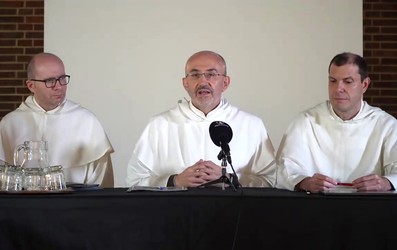
On 13 February 2026, Espacio O_LUMEN (Madrid) hosted the study day Spanish Masters of the Order of Preachers (17th–18th centuries). Assessment and new perspectives, organised in collaboration with the Historical Institute of the Province of Hispania and the Historical Institute of the Order of Preachers (Rome).
The meeting offered an overview of issues of governance and institutional relations, the life of the Dominican provinces in Europe and America, the value of documentation and catalogues as research tools, and attention to bibliographic heritage as a way to open up new lines of study.
Presentation and objectives of the conference
The opening session set the context for the seminar and emphasised the need to broaden the focus on the 17th and 18th centuries, which have traditionally received less attention, taking as its guiding thread the 17 Spanish friars who attained the office of Master of the Order. The presentation was given by the Prior Provincial of the Province of Hispania, Fray Javier Carballo OP, who insisted on avoiding presentism and promoting research in community in order to gain a deeper understanding of the historicity of the Dominican charism.
Rome, Madrid and the provinces: a connected history
Rome and the government of the American provinces in the 17th century – Massimo Carlo Giannini
Professor Massimo Carlo Giannini (University of Teramo) proposed a global reading that connects the Roman Curia, the Spanish Monarchy and the American provinces, highlighting the role of mendicant orders in the first globalisation and analysing internal tensions between Creoles and Peninsulars, mechanisms such as the “alternative” in positions of authority, and the importance of the procurator as a figure of negotiation. He also examined attempts at civil control over the order and the defence of its institutional unity.
F. Juan Tomás de Rocabertí and the Dominican nuns (1670-1676) – Emilio Callado Estela
Professor Emilio Callado Estela (UCH-CEU University) analysed the relationship between Master General Fr. Juan Tomás de Rocabertí OP and the Dominican nuns, highlighting his commitment to observance and the conflicts he faced (Poissy, the convent of the ‘Magdalenas’ in Valencia), together with his promotion of worship and female figures —including Saint Rose of Lima— and the case of Sister Hipólita de Jesús, where reform, politics and lineage intersect.
European perspectives: Hungary, Bohemia and the German space
Father Tomás Ripoll and the Domincan Province of Hungary – Tibor Martí
Historian Tibor Martí presented research based on correspondence from the General Archive of the Order (Rome) to describe the government of Friar Tomás Ripoll OP (1725–1747) in relation to the province of Hungary, reorganised with convents in Austria and Italy, highlighting his meticulous style in academic appointments, discipline and defence of privileges —such as the confraternities of the Rosary— as well as specific cases that illustrate a strict ‘paternity’.
The Masters of the Dominican Order in the Province of Bohemia in the 18th Century — Jakub Zouhar
Professor Jakub Zouhar explored the relationship between Rome and the Dominican province of Bohemia in the 18th century, from its Baroque ‘golden age’ to its decline due to wars and Josephine reforms, weaving together unique episodes that reveal the daily pulse of the general government: disciplinary disputes, cultural conflicts (such as ‘figural’ music in female convents) and even reports of vampire rumours in Moravia.
Master Fr. Juan Tomás de Boxadors (1756–1777) and the friars in Germany — Loris Serafini
Loris Serafini addressed the government of Fr. Juan Tomás de Boxadors OP in the German sphere (Teutonia, Saxony and the Austrian congregation) in the context of the Enlightenment and confessional tensions, highlighting communication problems and trips to Rome, friction with the Lutheran environment, cases of discipline and mercy after penance, disputes over jurisdiction and the debate on the language of preaching and publications in German.
Documentation and catalogues: counting to govern
Counting to govern: the 1761 catalogue under Boxadors — Alejandro López Ribao OP
Fray Alejandro López Ribao OP, director of the historical institute of the Province of Hispania, presented the discovery and reconstruction of the first complete catalogue of the Province of Spain (1761), ordered from Rome, as an institutional X-ray: number of religious and convents, economic inequalities, networks of affiliation and control of positions, and the administrative reading that led Boxadors to decisions of great impact, such as the closure of novitiates, highlighting the role of data as a tool for reform.
The government of Master J. Tomás de Boxadors regarding the Province of Hungary
Dr Viliam Štefan Dóci OP explored Boxadors' mode of government over the province of Hungary, highlighting two priorities: observance of the constitutions and excellence in studies, with an explicit Thomist commitment. He also pointed out archival challenges due to fragmented documentation and explained the terminological and disciplinary rigour applied in provincial chapters, as well as collaboration with the Viennese environment — including the figure of Gazzaniga — to articulate an academic “modernity” anchored in tradition.
With this set of contributions, the conference consolidated a map of issues and sources for further research into the Dominican government in the Modern Age, the movement of people and decisions between Rome and the provinces, and the value of documentary repertoires—catalogues, correspondence, and archives—as a basis for new historiographical perspectives.